

- Future of Work
- Critical Thinking
- AI
The Distance Between Thought and Thing
What changes when the distance between a question and what we can create to explore it begins to collapse, and judgment becomes a harder skill?
Briefing · Leadership / Transformation
Why legacy processes fail and how real change starts. Kotter’s model, Kaizen, and AI insights for leaders ready to evolve.

Change isn’t the problem, the comfort is. Many organizations cling to familiar processes even when they no longer serve their goals. This article explores why internal resistance derails progress, how frameworks like Kotter’s and Kaizen can guide real transformation, and why sometimes, an outsider is exactly what a company needs to move forward..
I was Zooming with a potential client. He leaned back in his chair like he owned the building. And in a way, he did, seventeen years at the same company, from project manager to SVP of Product.
The topic? Process. Specifically, UX delivery.
I pointed out the friction: handoffs, fragmented design systems, endless revisions, wasted hours. Tools could help. So could a few strategic workflow tweaks.
He nodded, then said it:
“The objective is to save money, but we can’t change the process.”
There it was, the corporate koan. Lower cost with zero disruption. Better results from the same ingredients. Magic thinking in a business suit.
Change for change’s sake isn’t the goal. Risk assessment is wise. But there’s a difference between caution and hiding behind legacy processes that stopped working years ago.
Most companies aren’t afraid of change. They’re afraid of admitting the old way isn’t working.
Processes become rituals, familiar, repeatable, comforting. People stick with them because they offer the illusion of control. Disrupting the ritual doesn’t just challenge the work, it threatens the identity built around it.
I’ve seen designers pour hours into spec documents no one reads. Developers stuck waiting on vague inputs. Teams locked in toolchains no one understands, but everyone defends.
All in the name of “how we’ve always done it.”
Meanwhile, the CFO wants costs down. The CEO wants faster shipping. And no one wants to be the person who asks:
“What if we stopped doing it this way?”
You don’t need a revolution. But you do need a method.
Here are three I trust:
Create urgency. Build a coalition. Get quick wins. Great for leaders stuck in analysis paralysis.
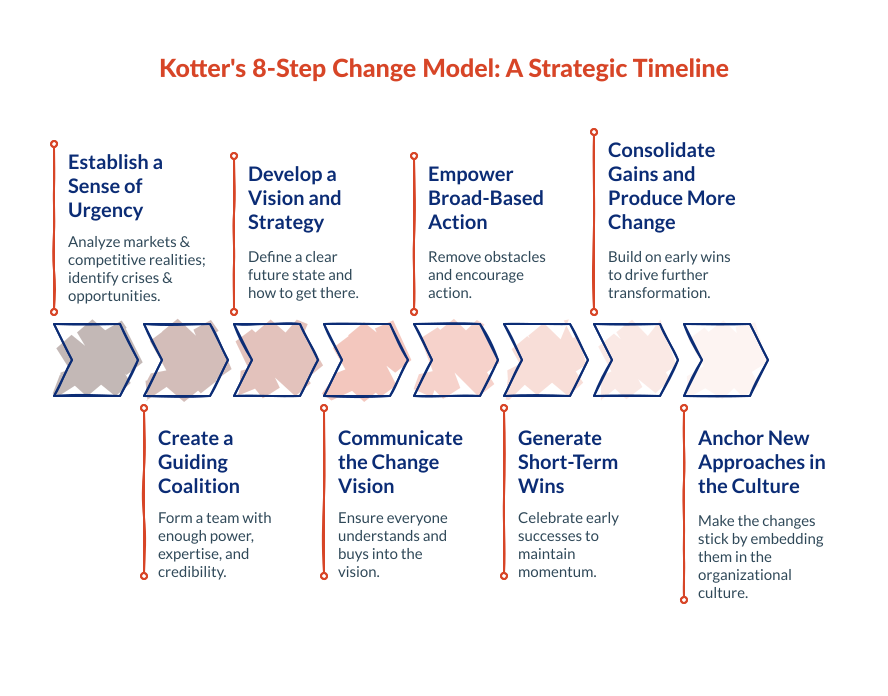
Awareness. Desire. Knowledge. Ability. Reinforcement. Focuses on people, not just process. One behavior at a time.
Continuous, incremental change. Small tweaks. Daily questions. Quiet momentum. Ideal for UX and product teams that hate disruption but need evolution.
Think of Kaizen as change management in sneakers, fast, quiet, constant. Pair it with AI: let the machine spot inefficiencies, then apply Kaizen to chip away at them.
It’s not a keynote. Not a slide. It’s work.
One hallway conversation. One habit challenged. One person who’s been there ten years finally admitting maybe this process isn’t sacred.
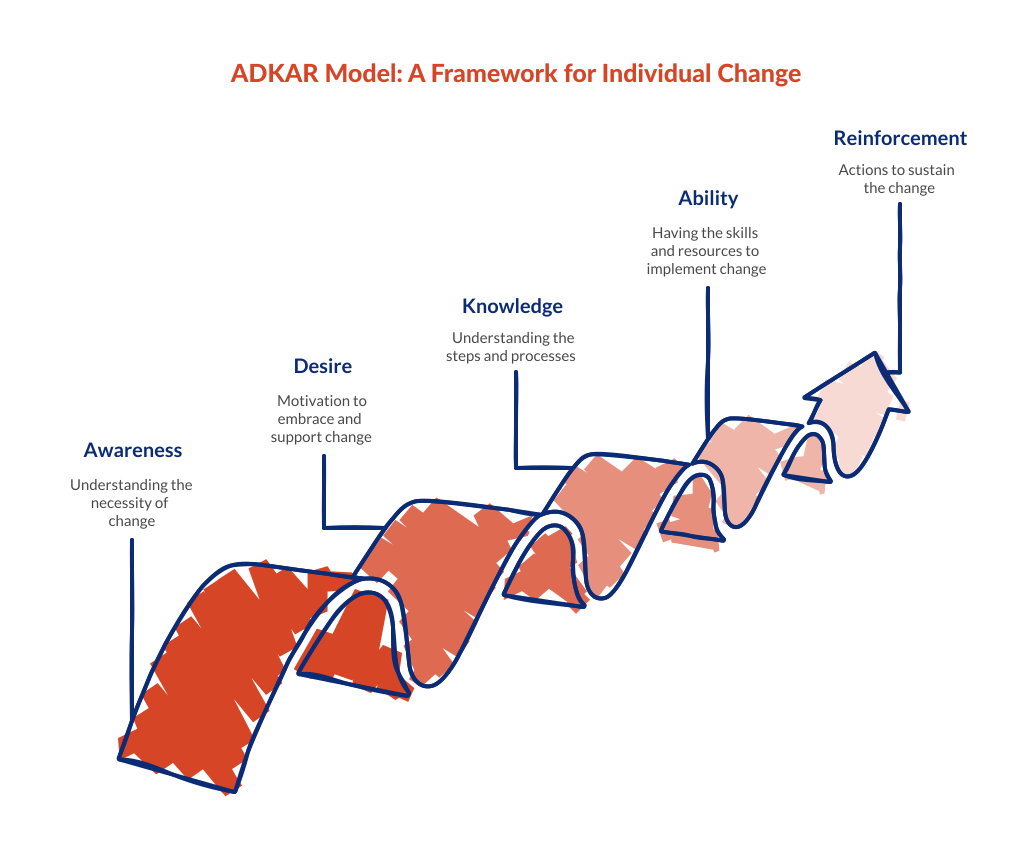
I like ADKAR because it’s simple. No jargon. Just human:
That’s not theory. That’s Monday morning.
Here’s what happens when someone internal tries to lead change:
They get eaten alive. Politely. With smiles and calendar invites.
It’s not about the idea. It’s about the baggage, past arguments, team turf, perceived ambition. People see a threat, not a fix.
That’s where outside help works.
We don’t owe anyone a promotion.
We don’t care who built the system.
We care if it works.
And most importantly: we leave.
We’re not sticking around to protect egos. That clarity means we can call out what others tiptoe around.
I once sat in a room where two directors wanted the same change, but refused to agree because neither wanted to give the other the win. We reframed it as an external insight.
Green light.
Not because it was new.
Because it wasn’t political.
That’s the power of an outsider:
We don’t just bring ideas.
We get them through.
If you’re the internal voice trying to push change, the climb is steeper. But it’s not hopeless.
Start with Kaizen in your sphere.
Track wins. Show data.
Build alliances with other forward-thinkers.
Your baggage? Yes, it’s a factor. But your knowledge of the terrain is also your strength.
Every internal shift chips away at the monolith of “how we’ve always done it.”
I was brought in to fix a mess.
Hundreds of web properties. Disconnected teams. Conflicting development goals. Nothing shipped on time.
The ask?
Rebuild the design system process. Streamline delivery. Get results.
So I did the work. Talked to stakeholders. Sat with devs. Mapped the stack. Spotted the rot: hours lost to handoffs, redundant components, manual cleanup.
Then I embedded, not as a spectator, but inside the fire. We launched multiple sites. Fast. Clean. Calm.
The new system cut waste. Tightened review loops. Designers stopped chasing specs. Devs stopped rewriting the same buttons.
It worked. So well, it won internal awards. Applause at the all-hands. Rolled out across regions.
Then came the meetings:
“We’re not sure this is the right way.”
“It’s good, but it’s not our process.”
Same people.
Same system.
Suddenly: resistance.
They didn’t want better. They wanted familiar, slightly faster.
You can give people everything they asked for. But if it doesn’t feel like the old way, they’ll burn it down, with a smile.
That’s why you need outside help. Not just to fix the work. To break the emotional grip on legacy systems. To say what no one inside can:
What got you here won’t get you further.
At a billion-dollar firm, I watched a lead dev print out user flows. Marked them up with a red pen. Scanned them back.
Why?
“That way, nothing slips through.”
You can’t keynote that out of someone. You show them a better way, and prove you’re not trying to erase them.
You’re trying to keep them in the game.
Kaizen sounds like a workshop. It’s not. It’s basic.
Pick the ugliest part of your process.
Ask: “Why do we do it this way?”
Then really listen.
Then change one thing.
Even if it fails, you’ve done more than most.
AI won’t save your team if your team can’t change.
It’ll just show you, faster, how inefficient you already are.
Right now, AI can:
But it won’t convince someone who got promoted for maintaining the status quo.
I watched a senior designer ignore an AI usability report.
“It doesn’t understand our users like I do.”
The irony?
The users agreed with the AI.
AI isn’t coming for jobs. It’s coming for habits.
Your competitors are already using it, leaner, faster, with half your headcount.
Picture this: AI flags that 30% of team queries are about button states already documented.
Kaizen asks, “How can we fix that?”
The fix? A Slackbot. A plugin. A better FAQ.
You don’t need to burn it all down. But you do need to ask hard questions about what you’ve built.
The best leaders don’t defend systems.
They challenge them.
Change doesn’t mean chaos.
It means relevance.
Start small.
Fix one broken link.
Automate one task.
Replace one pointless meeting with a live dashboard.
The SVP I talked to?
Still hasn’t changed the process.
Still wants to save money.
Still waiting for a miracle.
Don’t be that story.
Don’t let your leadership be defined by inaction.
“Great things are done by a series of small things brought together.”– Vincent Van Gogh
Want help fixing the one thing your team keeps stepping over?
I’m ready when you are.
Change is hard.
Stagnation is lethal.
Pick your pain.
Listen · AI-narratedSummary
0:00Selected from the same topics.
What changes when the distance between a question and what we can create to explore it begins to collapse, and judgment becomes a harder skill?

We cannot predict every way an AI agent might interpret us. The guardrail belongs where interpretation becomes a consequence.

B2E AI adoption fails when teams design around personas instead of functions, risks, trust barriers, and human control points.
Tell me what you are building, changing, or trying to make better. You do not need a polished brief.
Prefer email? info@uxdesignlab.com
I read every inquiry personally and usually reply within one business day.